- 3000+ Patterns Are Available
- 008617749755602
- yoyicassia@hotmail.com

Steel Door Panel: Types, Materials, Applications, Manufacturing Process and Buying Guide
A steel door panel is a formed metal sheet used to manufacture, repair, reinforce, or decorate steel doors for residential, commercial, industrial, and architectural applications. With excellent strength, dimensional stability, durability, and design flexibility, steel door panels are widely used for exterior doors, interior doors, security doors, fire-rated door systems, garage doors, and decorative metal doors.
Modern steel door panels can be manufactured with smooth, embossed, stamped, textured, or decorative surfaces. Depending on the application, manufacturers can produce panels from galvanized steel, cold rolled steel, stainless steel, or other metal materials.
For door manufacturers, distributors, contractors, and architectural metal suppliers, selecting the correct steel door panel sheet is important for achieving the required appearance, strength, corrosion resistance, and production efficiency.
What Is a Steel Door Panel?
A steel door panel is a flat or formed sheet of steel designed to become part of a complete door assembly. It can be used as the main door face, door skin, decorative exterior surface, or structural component of a steel door.
Unlike a complete steel door, a steel door panel is usually supplied as a sheet or pre-formed component. Door manufacturers can combine the panel with a frame, core material, reinforcement, hinges, locks, and other hardware to produce a finished door.
Steel door panels are available in different:
- Steel grades
- Thicknesses
- Widths and lengths
- Surface finishes
- Embossed patterns
- Stamped designs
This flexibility makes steel door panels suitable for both mass production and customized door manufacturing.
Main Types of Steel Door Panels
Different applications require different steel door panel designs. The following are some of the most common types used in the door industry.
1. Flush Steel Door Panel
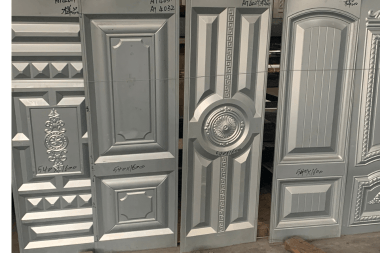
A flush steel door panel has a flat surface without embossed patterns. It provides a clean, modern appearance and is commonly used for residential, commercial, industrial, and utility doors.
Smooth panels are particularly suitable for applications where the final door will be painted, powder coated, laminated, or otherwise finished after fabrication.
2. Embossed Steel Door Panel
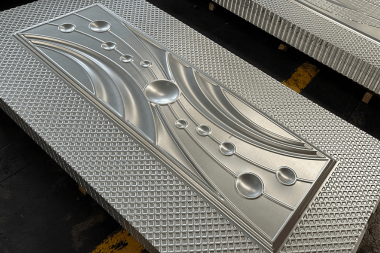
An embossed steel door panel is manufactured by pressing a pattern into the surface of the steel sheet.
Embossing can create:
- Raised decorative patterns
- Geometric designs
- Wood-grain effects
- Recessed sections
- Door panel profiles
- Architectural textures
The embossed design can improve the visual appearance of a finished door while also providing additional surface definition.
3. Stamped Steel Door Panel
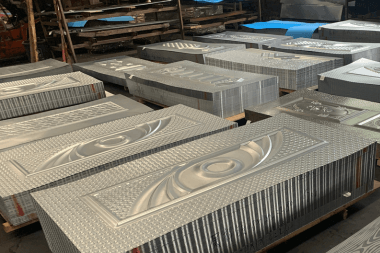
A stamped steel door panel is produced using a stamping or pressing process. A metal forming die creates a specific design, profile, or configuration in the steel sheet.
Stamped steel door panels are widely used in large-scale door manufacturing because stamping allows manufacturers to produce consistent patterns repeatedly.
4. Galvanized Steel Door Panel
A galvanized steel door panel is manufactured from steel coated with zinc to improve resistance to corrosion.
Galvanized steel is particularly useful for:
- Exterior doors
- Entry doors
- Industrial doors
- Commercial buildings
- Utility doors
For outdoor applications, galvanized steel door panels can provide a useful combination of strength, corrosion resistance, and cost efficiency.
5. Decorative Steel Door Panel
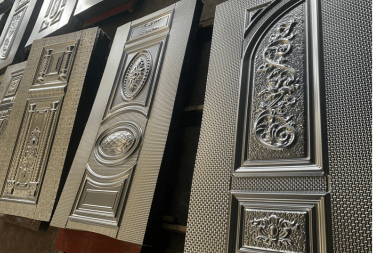
A decorative steel door panel combines the durability of steel with a patterned or architectural surface.
Decorative panels can feature:
- Floral patterns
- Geometric patterns
- Modern lines
- Traditional designs
- Wood-effect textures
- Custom embossed patterns
They are commonly used for residential entrance doors, villa doors, apartment doors, commercial entrances, and architectural projects.
6. Textured Steel Door Panel
A textured steel door panel has a specially formed surface designed to create a distinctive visual or tactile effect.
Textured surfaces can be used to imitate natural materials such as wood while retaining the structural properties of steel.
Materials Used for Steel Door Panels
The material selected for a steel door panel affects its strength, corrosion resistance, formability, surface quality, and final cost.
Galvanized Steel
Galvanized steel is one of the most commonly used materials for exterior steel door panels.
Its zinc coating helps protect the underlying steel from corrosion. This makes galvanized steel suitable for doors exposed to moisture, changing weather conditions, and outdoor environments.
Cold Rolled Steel
Cold rolled steel provides a smooth and consistent surface that is suitable for pressing, stamping, embossing, painting, and powder coating.
It is often selected for applications where surface appearance and forming performance are important.
Common Steel Door Panel Thicknesses
The appropriate thickness depends on the final door construction, forming requirements, application, and required strength.
Common steel sheet thicknesses used for door panels may include approximately:
- 0.6 mm
- 0.7 mm
- 0.8 mm
- 0.9 mm
- 1.0 mm
- 1.2 mm
- 1.5 mm
The actual thickness should be selected according to the door design and manufacturing requirements.
For embossed or stamped applications, the relationship between sheet thickness, material strength, die design, and forming depth is particularly important.
Steel Door Panel Sizes
Steel door panels can be supplied in standard or customized dimensions.
Typical dimensions depend on the finished door size and the manufacturing process. A supplier may provide:
- Standard door skin sizes
- Cut-to-size steel sheets
- Full-size sheets
- Pre-formed door skins
- Custom embossed panels
- Custom stamped panels
For large-volume door manufacturing, customized steel door panel sizes can help reduce material waste and improve production efficiency.
Steel Door Panel Manufacturing Process
The manufacturing process for a steel door panel depends on the panel design and material.
Step 1: Steel Sheet Selection
The manufacturer selects the appropriate steel material according to the required thickness, grade, surface quality, and application.
For exterior doors, galvanized steel may be selected for improved corrosion resistance.
Step 2: Sheet Cutting
The steel sheet is cut to the required dimensions using equipment such as:
- Shearing machines
- CNC cutting equipment
- Laser cutting machines
- Slitting equipment
Accurate cutting is important for maintaining consistent panel dimensions.
Step 3: Surface Preparation
Depending on the production requirements, the steel sheet may undergo cleaning, leveling, degreasing, or other surface preparation processes.
Proper surface preparation helps improve the quality of subsequent forming and coating operations.
Step 4: Embossing or Stamping
For patterned products, the sheet is placed into a forming or stamping machine.
A specially designed die applies pressure to create the required pattern.
This process can produce an embossed steel door panel, stamped steel door panel, or other decorative metal door design.
Step 5: Edge Forming
The panel edges can be bent or formed according to the final door construction.
Accurate edge forming helps ensure that the panel can be properly assembled with the door frame and other components.
Applications of Steel Door Panels
Steel door panels are used in a wide range of applications.
Residential Doors
Steel panels are commonly used for:
- Front entrance doors
- Back doors
- Garage doors
- Apartment doors
- Security doors
- Utility doors
- Exterior residential doors
Decorative embossed designs can provide a more attractive appearance for residential entry doors.
Commercial Doors
Commercial buildings often require durable and low-maintenance door systems.
Steel door panels can be used for:
- Office buildings
- Retail stores
- Warehouses
- Hotels
- Schools
- Hospitals
- Apartment buildings
Industrial Doors
Industrial applications may require stronger and more durable door structures.
Steel door panels can be incorporated into:
- Factory doors
- Workshop doors
- Storage facility doors
- Equipment rooms
- Industrial partitions
- Utility access doors
Architectural Doors
Decorative and textured steel panels can also be used in architectural projects where both appearance and durability are required.
Custom patterns can help architects and door manufacturers create distinctive entrance designs.
Steel Door Panel vs. Steel Door Skin
The terms steel door panel and steel door skin are often used interchangeably, but they can describe slightly different products depending on the manufacturer.
A steel door skin generally refers to the outer steel sheet covering a door core or door structure.
A steel door panel can refer more broadly to a formed sheet or individual panel used in the construction of a door.
In the door manufacturing industry, suppliers may use both terms to describe similar products.
For product sourcing, useful related searches include:
- Steel door skin
- Steel door skin sheet
- Metal door skin
- Galvanized steel door skin
- Stamped steel door skin
- Embossed door skin
- Decorative steel door skin
How to Choose the Right Steel Door Panel
When purchasing steel door panels, several factors should be considered.
1. Material
Choose galvanized steel when corrosion resistance is important. Cold rolled steel may be suitable for applications requiring good surface quality and forming performance.
2. Thickness
Select the appropriate thickness according to the door construction, forming depth, strength requirements, and manufacturing process.
3. Pattern
Choose between smooth, embossed, stamped, textured, or custom designs depending on the desired appearance.
4. Surface Finish
Consider whether the panel will be painted, powder coated, galvanized, or given another decorative finish.
5. Dimensions
Confirm the exact panel length, width, thickness, and forming dimensions before ordering.
6. Production Volume
For high-volume production, manufacturers may benefit from custom dies and standardized panel dimensions.
7. Supplier Capability
A reliable steel door panel manufacturer should be able to provide consistent material quality, accurate forming, customized designs, and stable production capacity.
Custom Steel Door Panels
Many door manufacturers require custom designs rather than standard panels.
A custom steel door panel can be developed according to:
- Door dimensions
- Embossing pattern
- Stamping design
- Material thickness
- Steel grade
- Surface finish
- Edge configuration
- Production volume
Custom tooling can be developed for unique embossed and stamped patterns. This is particularly useful for door manufacturers that sell proprietary designs or want to create a distinctive product range.
Steel Door Panel Manufacturer and Supplier
Choosing the right steel door panel supplier is important for maintaining product quality and production efficiency.
A professional supplier should ideally provide:
- Multiple steel material options
- Standard and custom sizes
- Embossing and stamping capabilities
- Custom tooling
- Stable production capacity
- Quality inspection
- Surface finishing options
- Export packaging
- Technical support
For international buyers, it is also useful to confirm packaging specifications, loading capacity, production lead times, sample availability, and customization capabilities before placing a bulk order.
Why Choose Galvanized Steel for Exterior Door Panels?
Exterior doors are exposed to rain, humidity, temperature changes, and other environmental conditions.
A galvanized steel door panel provides a protective zinc layer over the steel substrate. This helps reduce the risk of corrosion and makes galvanized steel a practical choice for many exterior door applications.
When combined with appropriate primer, paint, or powder coating, galvanized steel can provide additional protection and a longer-lasting decorative finish.
Steel Door Panel Surface Finishes
The final appearance of a steel door panel depends heavily on its surface finish.
Popular options include:
Powder Coating
Powder coating provides a durable decorative surface and is available in many colors and textures.
Painted Finish
Painted steel panels can be produced in different colors and customized according to project requirements.
Wood-Grain Finish
A wood-effect finish can give steel panels the visual appearance of natural wood while maintaining the durability of metal.
Metallic Finish
Metallic finishes can create a modern architectural appearance for commercial and residential doors.
Frequently Asked Questions About Steel Door Panels
What is a steel door panel?
A steel door panel is a flat or formed steel sheet used as part of a door assembly. It can function as a door skin, decorative face, or structural panel.
What steel is used for door panels?
Common materials include galvanized steel, cold rolled steel, and stainless steel. The best material depends on the required corrosion resistance, strength, forming performance, appearance, and budget.
What is a steel door skin?
A steel door skin is the outer metal sheet covering a door structure or core. It may be smooth, stamped, embossed, or textured.
Are galvanized steel door panels suitable for exterior doors?
Yes. Galvanized steel is commonly used for exterior applications because its zinc coating provides improved resistance to corrosion.
Can steel door panels be customized?
Yes. Manufacturers can customize dimensions, thickness, embossing patterns, stamping designs, edge configurations, and surface finishes according to production requirements.
Can steel door panels be painted?
Yes. Steel door panels can be finished with paint, powder coating, primer, or other compatible surface treatments.
How thick should a steel door panel be?
There is no single thickness suitable for every application. The required thickness depends on the door design, material grade, forming process, strength requirements, and applicable standards.
Where are steel door panels used?
They are used in residential doors, commercial doors, industrial doors, security doors, garage doors, apartment doors, utility doors, and architectural entrance systems.
Conclusion
A steel door panel is an important component in modern door manufacturing, offering a combination of strength, durability, design flexibility, and production efficiency. From smooth galvanized panels to embossed, stamped, textured, and decorative designs, steel door panels can be customized for a wide variety of residential, commercial, industrial, and architectural applications.
When selecting a steel door panel, buyers should consider material type, thickness, dimensions, surface finish, pattern, application environment, and supplier manufacturing capabilities. For exterior applications, galvanized steel is a popular choice because of its corrosion resistance, while cold rolled steel and stainless steel can meet other specific performance and appearance requirements.
For door manufacturers and distributors, working with an experienced steel door panel manufacturer and supplier can provide access to customized sizes, embossed patterns, stamping dies, surface finishes, and large-volume production.
Whether you need a standard steel door panel sheet, a galvanized steel door panel, an embossed steel door panel, or a fully customized decorative steel door panel, selecting the right material and manufacturing process is essential for producing reliable and attractive finished doors.